Leadership Training in Dubai Silicon Oasis for Technical Leaders
Leadership Training in Dubai Silicon Oasis helps engineers, product owners and founders become managers people want to follow. Leaders practise hands on with situations taken from their own teams, using role plays and peer coaching.
- Built for technical people who now lead
- Case work on issues in your teams
- Results reviewed with you at 90 days
- Rated 4.9/5 by 200,000+ professionals
- Certificate for every participant

Why technical companies here pick our programme
Speaks the language of engineers
Our faculty explain leadership with logic and evidence, which suits analytical minds who distrust vague advice and want to know why something works.
Rehearsal over reading
Practice takes roughly 80% of every session. Leaders run tough conversations, test decisions on current cases and get coached by colleagues.
Faculty who have shipped products
Facilitators have led R&D groups, scaled startups and managed global product teams, so their examples sound like the week your managers just had.
English or Arabic delivery
Mixed nationality cohorts usually work in English. Teams serving Arabic speaking clients or government entities can have sessions partly or fully in Arabic.
Proof of completion
Finishing the programme brings a TrainingInUAE.com certificate, useful for promotion files and for showing the investment the company made in them.
A clear business metric
Retention of key engineers, delivery against roadmap or team survey scores. We agree one up front and come back with the numbers after 90 days.

Leadership Training in Dubai Silicon Oasis that leaders practise
Technical managers rarely fail because they lack a framework. They struggle because they avoid the awkward talk with a brilliant but difficult engineer. Practice gives them the words and the confidence, so we keep explanation short and spend the time rehearsing.
Input from line managers
We collect a light 360 or speak with the managers above each participant to see how they lead day to day.
Find the pattern
Typical findings include leaders who still code instead of coaching, or who avoid conflict until a resignation lands.
Write cases from your teams
Anonymised situations from your product teams, labs or client projects become the scenarios leaders work through in the room.
Play it out
Leaders practise the conversation or decision in trios, with one observer scoring against a simple checklist and offering feedback.
Thirty days of trying it
Back at work, every participant tries one specific change, then shares evidence of what happened with their peer partner.
Measure after 90 days
We meet HR and the sponsor to review the agreed metric, leader feedback and next steps for the cohort.

A typical day has three or four short inputs. Everything else is leaders working in small groups on a live case, playing both sides of a conversation and giving structured feedback to each other.
- Laptops open from the first 15 minutes
- Your own documents, data and tasks
- A finished output from every lab
- Prompt library to keep using on Monday
Inside our Leadership Training in Dubai Silicon Oasis
The programme draws on eight modules. A first cohort usually takes four of them, and later cohorts add more. Every module rests on practice with situations your leaders are handling right now.
Module 1. Leading across many cultures
Managing engineers and specialists from South Asia, Europe, the Arab world and beyond, each with different views on authority, speaking up and deadlines.
🛠 Leaders practise: A one to one with a quiet team member who never raises problems
Module 2. Coaching technical talent
Asking better questions instead of supplying the answer, and giving clear feedback on behaviour as well as on technical output.
🛠 Leaders practise: A coaching session with a peer on a real performance concern
Module 3. Letting go of the work
Delegating properly when you were promoted for being the best engineer in the room, and holding people accountable without taking tasks back.
🛠 Leaders practise: A handover of one piece of their own work to a team member
Module 4. Deciding with imperfect data
Making calls on priorities, scope and people when the data is incomplete and the client or headquarters wants an answer now.
🛠 Leaders practise: A priority call on a current roadmap conflict, argued to the group
Module 5. Taking teams through change
Leading through reorganisations, new tools, mergers or a startup's growth from twenty to two hundred people, and handling resistance honestly.
🛠 Leaders practise: A talk to the team about an upcoming change, with tough questions
Module 6. Influencing without authority
Persuading other teams, headquarters and clients when you depend on them but cannot instruct them, using evidence and relationships.
🛠 Leaders practise: A pitch for resources to a sceptical senior stakeholder
Module 7. Building a team that delivers
Clear goals, healthy debate and shared standards that keep a product or engineering team performing as headcount and pressure rise.
🛠 Leaders practise: A team agreement on how decisions and disagreements will be handled
Module 8. Leading where AI meets the team
Deciding where AI fits in a team's work, setting sensible rules on its use and reading delivery data without losing sight of people.
🛠 Leaders practise: An AI adoption plan for their team, challenged by peers
Designed around your company and its leaders
A semiconductor design centre and a forty person SaaS startup face different leadership problems. We begin with your business, your growth stage and the people in the cohort.
Understand the business
A call with the sponsor and HR covers growth plans, attrition hotspots and what senior management expects from its managers.
Use your situations
Release crunches, client escalations and promotion decisions become the material for practice, with names and sensitive details removed.
Match depth and language
Content and pace change for team leads versus directors, and the group decides whether to work in English, Arabic or both.
Programmes for every leadership level
First time managers
For engineers and specialists in their first lead role, learning to coach, delegate and run good one to ones.
Middle managers
For heads of engineering, product or delivery who manage team leads and must turn strategy into clear priorities.
Senior leaders and executives
For site heads, founders and directors steering growth, culture and the relationship with investors or headquarters.
High potential talent
For rising technical talent marked as future leaders, with stretch assignments and a project reviewed by senior management.
Recognition when leaders finish
When the final module ends, your managers each take away a TrainingInUAE.com completion certificate that shows the modules attended and the time spent practising. Think of it as a record of in-house development. It is not a KHDA award, and nobody sits an external test.
- Issued to every participant who completes the hands on labs
- Shows the programme name, hours, tools covered and date
- Digital PDF, ready to add to LinkedIn and HR records
- Attendance and lab completion report for HR or L&D, on request

Who we train in Dubai Silicon Oasis
Most cohorts come from technology companies in the zone, from multinational engineering sites to founder led startups that began at Dtec. Teams are international and deeply technical.
Software and SaaS
Engineering and product managers balancing release pressure, technical debt and the need to grow junior developers into leaders.
Electronics and semiconductors
Leaders of design, test and engineering groups who manage highly specialised people on long, exacting projects.
Cybersecurity
Managers of security operations and consulting teams who work under pressure, often on shifts, with scarce and sought after talent.
Founder led startups
Founders and early hires who suddenly manage managers and need structure that does not kill the startup's energy.
Robotics and connected devices
Research and product leaders turning prototypes into products, coordinating engineers, data scientists and commercial teams.
Future mobility
Leaders in mobility and automotive technology firms managing partners, pilots and cross functional engineering teams.
Teams our trainers have worked with














Plus 400+ enterprise clients across 16+ countries.
Facilitators who have led technical teams
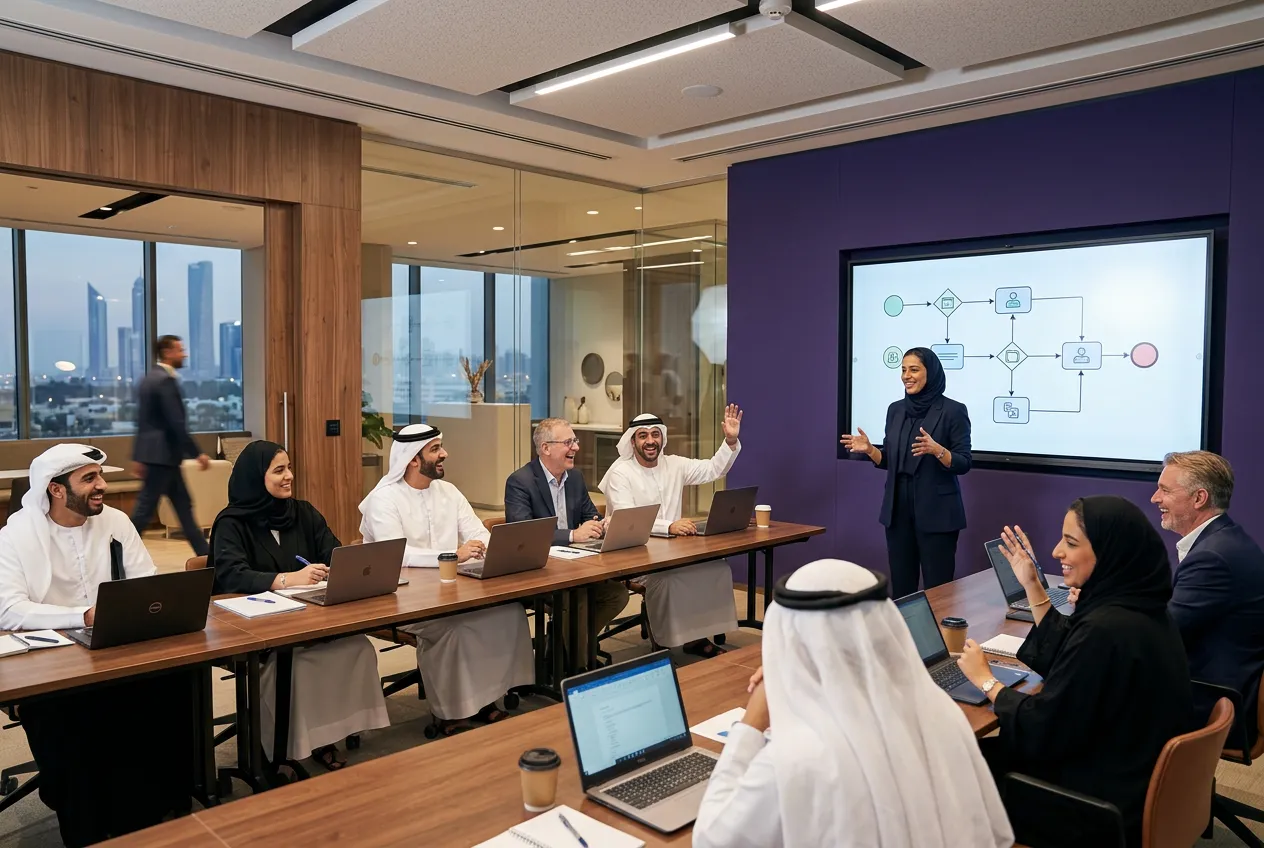
Leadership Training in Dubai Silicon Oasis is delivered by facilitators who have led engineering, product and R&D teams. They respect technical depth and know how hard the shift to management feels.
Leadership and management faculty
For managers, senior leaders and leadership offsites
- Senior people who have run teams and led change
- Drawn from a visiting faculty network across 9 IIMs
- Coaching, decision making and difficult conversations
- English, Arabic or bilingual delivery
Sales and customer trainers
For sales, account and service teams
- Practitioners who have closed deals and run sales teams
- Role plays built on your real deals and customers
- Discovery, objection handling and negotiation
- B2B, retail and hospitality experience
AI and digital trainers
For AI adoption and productivity programmes
- 17+ years in AI and corporate training
- Have trained 200,000+ professionals in 16+ countries
- Copilot, ChatGPT, Claude and Gemini on real work
- Part of a pool of around 300 trainers worldwide
Leading in a free zone where people live and work
The Dubai Integrated Economic Zones Authority oversees Dubai Silicon Oasis, a free zone built for technology businesses. Its business community spans clusters such as cybersecurity, electronics, robotics and future mobility, and Dtec, its startup campus, keeps a steady stream of young companies arriving. Many leaders run local sites of international groups and report to a headquarters in another time zone. Others lead startups that now need structure without losing speed.
Engineers are in demand across the UAE, so a manager’s ability to coach and retain people directly affects delivery. That is why our Leadership Training in Dubai Silicon Oasis treats leadership as a retention tool. The zone sits where Sheikh Mohammed bin Zayed Road meets Dubai to Al Ain Road and has no metro station, so most sessions run on your premises. For an offsite, teams often choose a hotel elsewhere in Dubai or a desert venue further along the Al Ain road.

Ways to run the programme
Half day masterclass
A four hour session on one skill, such as delegation, that fits around sprint ceremonies and release dates.
Leadership team offsite
A day or two away for the senior team, combining leadership practice with planning and team agreements.
Cohort series
Monthly or fortnightly sessions for the same group, with practice assignments carried out between meetings.
Full day workshop
Two or three connected modules in one day, with no more than 20 participants per trainer.
Live online
Virtual sessions with breakouts for leaders based in different countries or working hybrid patterns.
Leadership Training in Dubai Silicon Oasis: FAQs
How long does a leadership programme for technical managers take?
It depends on the depth you need. A single skill fits a half day masterclass. A first serious programme is usually four to six sessions over three or four months, so leaders apply each skill before moving on. Senior teams often prefer a one or two day offsite. We propose a shape once we know the goal and the time your leaders can spare.
Do you offer 360 feedback before the programme?
We can. A short online 360 asks each leader’s own boss, several peers and their team how they lead. Engineers tend to value this data because it replaces opinion with evidence. Each leader sees their own report and uses it to choose a focus, while HR receives only anonymised group themes. A lighter option is a few interviews with line managers.
Can sessions be run in Arabic?
Yes, Arabic delivery is available, as is English or a bilingual blend. Most cohorts in Dubai Silicon Oasis are highly international and choose English, but some groups, especially those working with government or Arabic speaking clients, prefer to practise key conversations in Arabic. We choose the facilitator to match the language.
How many managers fit in one cohort?
Twenty is our ceiling for each trainer in a hands on workshop. Beyond that, role plays get rushed and fewer leaders hear useful feedback. A bigger population of managers is split across extra trainers or repeat dates. If you want a single talk for all managers to launch the programme, that can be any audience size.
Which offsite venues suit a team based in Dubai Silicon Oasis?
Regular sessions usually run in your own meeting rooms, which saves travel since many staff live in the zone. For an offsite, teams often choose a hotel elsewhere in Dubai or a desert venue along the Al Ain road. We help plan an agenda that suits the venue, while the booking stays between you and the venue.
Will leaders get a certificate?
Yes. Leaders who attend the whole programme are handed a TrainingInUAE.com completion certificate with their modules and practice hours on it. Technical companies often add it to promotion files. Be clear internally that this is not KHDA accredited, and no outside body sets an exam.
Is recording allowed?
We can record short teaching segments for internal use if this is agreed in advance. Role plays are usually left unrecorded, because leaders practise more openly without a camera. If some managers cannot attend, a live online repeat often works better than a recording, since they still get to practise.
How will we know the programme made a difference?
We agree a measure before we start, for example attrition among engineers, delivery against plan or team survey results. After the sessions, each leader takes on a month long challenge at work. Three months after the start, HR, the sponsor and our faculty look again at that measure, together with leader and manager feedback, and summarise the findings in a short report.
Turn strong engineers into strong leaders
Explore more in Dubai Silicon Oasis and nearby
More training in Dubai Silicon Oasis
Nearby locations
The UAE’s one stop shop for corporate training. Hands on workshops delivered across Dubai and all seven emirates. Licensed UAE company registered in Ajman, with a delivery team based in Dubai.
- AI Agents and Automation Training: Build Working Workflows
- ChatGPT Training for Everyday Business Work
- Claude AI Training for Document Heavy Teams
- Microsoft Copilot Training for Microsoft 365 Users
- Prompt Engineering Training Across Every Major AI Tool
- Business Writing Training
- Communication Skills Training
- Presentation Skills Training
- All programmes
© 2026 TrainingInUAE.com. All rights reserved.