Home / Programmes / Critical Thinking Training Dubai
Critical Thinking Training Dubai: Sharper Judgement at Work
Critical Thinking Training Dubai teams can use the next morning, built around checking claims, spotting weak logic and making a clear case. Participants practise hands on, using the business cases, briefs and AI drafts that cross their own desks.
- Real documents from your business, not puzzles
- Checking AI answers before they spread
- Each attendee leaves with a certificate
- Rated 4.9/5 by 200,000+ professionals
- Certificate for every participant
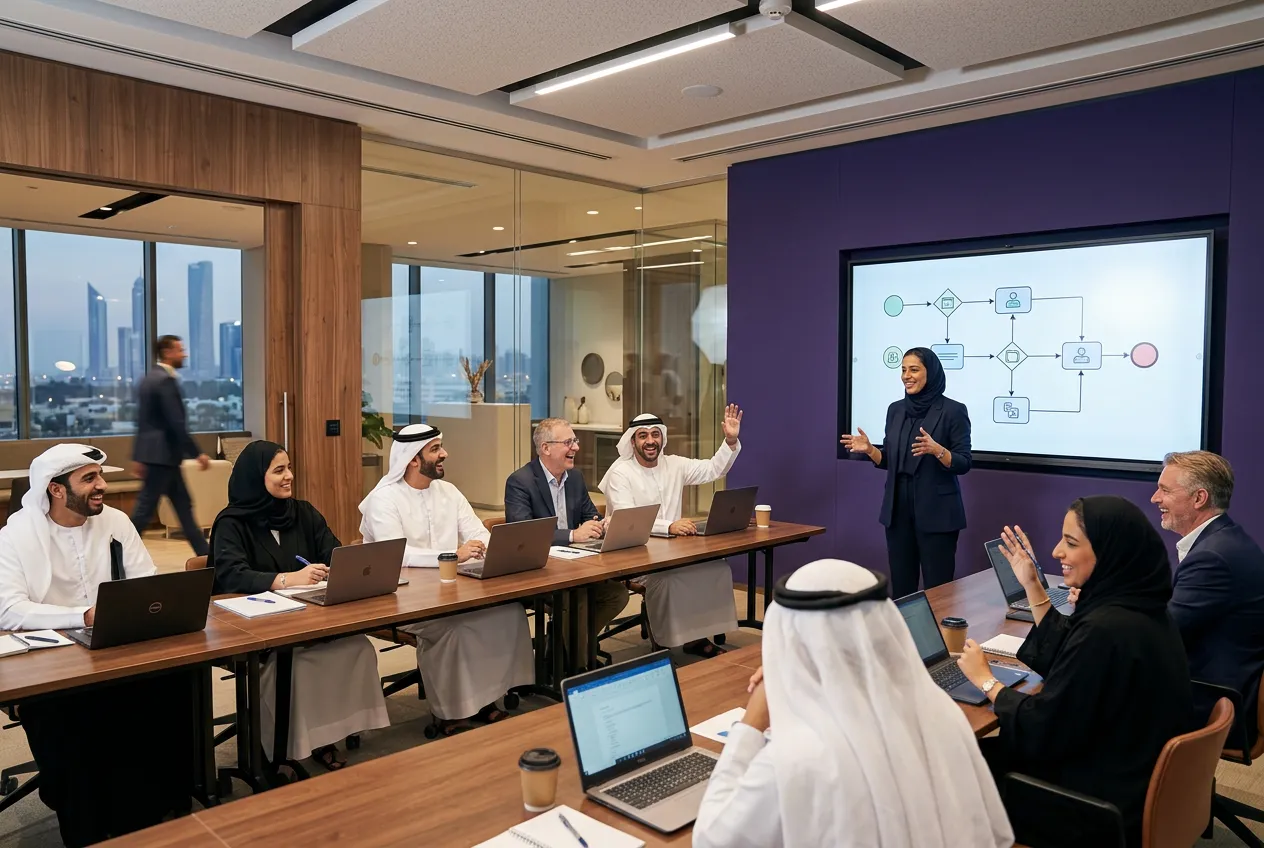
Why teams ask for a reasoning workshop
Your paperwork is the material
We use the board papers, vendor pitches and monthly dashboards your staff already read. Judging a real recommendation teaches far more than abstract logic games ever will.
Fewer decisions on autopilot
People learn to pause on the claims that matter, ask what evidence sits behind them and notice when a conclusion arrives before the facts.
Built for the AI era
Generative AI produces fluent text that can still be wrong. Participants practise checking sources, numbers and reasoning in AI answers before anything reaches a client.
Facilitators who have decided things
Our trainers have approved budgets, rejected proposals and lived with the results. They bring examples from boardrooms and project sites, not only from textbooks.
A record of learning
Completing the workshop earns each person a TrainingInUAE.com completion certificate, which HR can file against individual development plans.
One indicator, chosen together
Before we start, we pick one indicator with you, such as rework on reports or the quality score of proposals, and report movement at 90 days.

How the critical thinking workshop runs in practice
Nobody becomes a better thinker by hearing a lecture on fallacies. People improve when they take apart a real argument, defend a view under questioning and see a colleague find the hole they missed. Every session is built around those moments.
Collect real cases
Before the session we gather a few anonymised documents from your teams: a business case, a supplier claim, a summary someone wrote under time pressure.
One framework at a time
The trainer introduces a single tool, such as separating claims from evidence, and shows it working on a familiar example.
Pull the argument apart
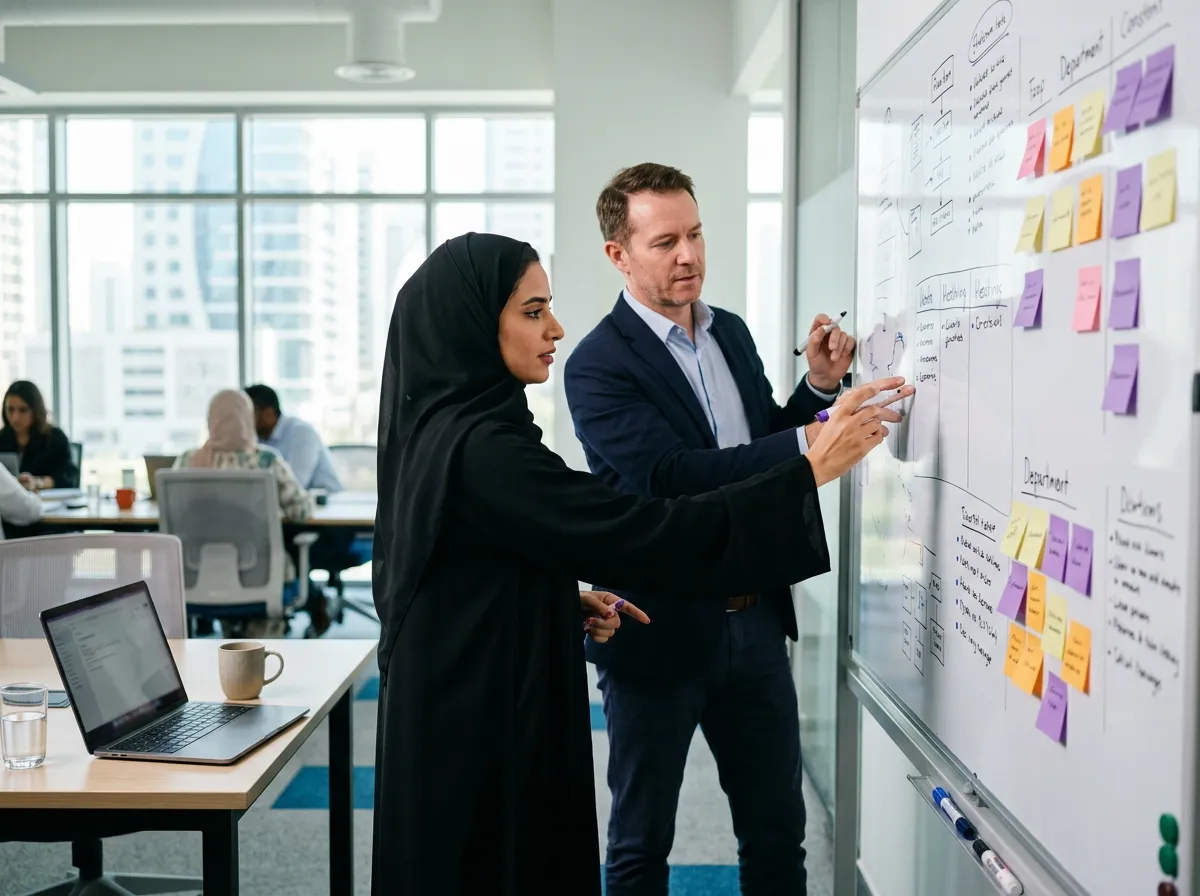
Small groups map the logic of a real paper, mark unsupported claims and list the questions they would put to its author.
Defend and challenge
Participants present a position and face respectful challenge from peers, learning to stay calm while their reasoning is tested.
Keep a question checklist
Everyone walks out with a single sheet of review questions to run on the next report or proposal that lands on their desk.
Check back after 90 days
We revisit the agreed indicator with you, gather examples of better decisions and suggest a follow up if gaps remain.

Exercises fill about 80% of the clock. The trainer gives a short framework, then groups apply it to a document, a data set or a live debate drawn from the participants’ own work.
- Laptops open from the first 15 minutes
- Your own documents, data and tasks
- A finished output from every lab
- Prompt library to keep using on Monday
What our Critical Thinking Training Dubai course covers
The eight modules move from noticing how our own minds take shortcuts to evaluating other people’s arguments and finally building and presenting a sound case. One day handles the essentials, while a second day opens room for deeper casework.
Module 1. What critical thinking means at work
Why smart people still make poor calls, the difference between being sceptical and being negative, and where careful thought pays off most in daily work.
🛠 Participants practise: Review a past team decision and name where scrutiny was missing
Module 2. Claims, evidence and assumptions
Breaking any statement into what is asserted, what supports it and what is quietly taken for granted. The foundation for everything that follows.
🛠 Participants practise: Highlight claims and hidden assumptions in a real internal memo
Module 3. Cognitive biases in the office
Confirmation bias, anchoring, sunk cost and groupthink, shown through workplace examples, plus simple habits that reduce their pull on a meeting.
🛠 Participants practise: Spot the biases at work in a recorded decision scenario
Module 4. Reading numbers and charts
Averages that hide spread, percentages without a base, truncated axes and correlation sold as cause. Enough data sense to ask the right question.
🛠 Participants practise: Critique a dashboard or chart taken from your own reporting
Module 5. Checking AI output and online sources
How generative AI can invent facts or citations, how to verify a source quickly and when a rumour or forwarded message deserves doubt before sharing.
🛠 Participants practise: Fact check an AI generated summary against its source documents
Module 6. Weighing options and trade offs
Comparing alternatives against clear criteria, separating what is urgent from what is important and recognising when more information will not change the answer.
🛠 Participants practise: Score three real options for a current team decision
Module 7. Building a sound argument
Structuring a recommendation so the conclusion follows from the evidence, anticipating objections and stating uncertainty honestly instead of hiding it.
🛠 Participants practise: Rewrite a weak recommendation paper into a clear, supported case
Module 8. Questioning well with colleagues
Challenging ideas without damaging relationships, asking open questions in hierarchy sensitive settings and running a short pre mortem before a big commitment.
🛠 Participants practise: Run a pre mortem on a project your team is about to start
Shaped around the decisions your people make
An auditor, a procurement officer and a marketing lead face very different arguments every week. We look at the decisions your participants own and choose cases, data and examples that match their daily judgement calls.
Short diagnostic call
We ask which decisions go wrong most often, where reports cause rework and what level of seniority will be in the room.
Cases from your files
With your approval, anonymised proposals, reports and data become the exercises, so practice transfers straight into the job.
Matched to seniority and language
Junior analysts and senior managers get different depth, and the trainer switches between English and Arabic when the room needs it.
Built for every level
Senior leaders
Testing the papers that reach them, challenging consensus in leadership meetings and reducing the risk of costly strategic mistakes.
Managers
Reviewing team work critically, coaching staff to reason clearly and making balanced calls under time pressure.
Analysts and specialists
Interpreting data honestly, writing supported recommendations and checking AI generated content before it is used.
Early career staff
Building early habits of questioning sources, structuring arguments and speaking up with evidence in meetings.
Recognition for completing the course
Each participant who finishes the course is given a TrainingInUAE.com certificate of completion naming the reasoning skills practised. Treat it as proof of in-house development for your learning records. It is not an accredited academic qualification.
- Issued to every participant who completes the hands on labs
- Shows the programme name, hours, tools covered and date
- Digital PDF, ready to add to LinkedIn and HR records
- Attendance and lab completion report for HR or L&D, on request

Where careful reasoning matters most
Any team that turns information into decisions benefits from sharper thinking. These sectors ask us most often because a weak assumption can be expensive, public or hard to reverse.
Banks and investment firms
Credit, risk and investment teams judging proposals, models and market claims where an unchecked assumption can become a loss.
Government entities
Policy and strategy staff weighing evidence for initiatives and preparing recommendations that senior officials can rely on.
Consulting and professional services
Advisers who must challenge client data politely and build conclusions that survive scrutiny from demanding stakeholders.
Technology and digital
Product teams reading user data, testing feature hypotheses and avoiding decisions driven by the loudest voice in the room.
Energy and engineering
Project leaders comparing technical options, contractor claims and risk reports on long, high value programmes.
Healthcare administration
Managers interpreting performance data, reviewing vendor evidence and planning service changes with patient impact in mind.
Teams our trainers have worked with














Plus 400+ enterprise clients across 16+ countries.
Trainers who have made the hard calls
Our facilitators are senior practitioners from strategy, finance and operations roles. They have read thousands of proposals, sat on decision committees and know which questions separate a strong case from a polished one.
Leadership and management faculty
For managers, senior leaders and leadership offsites
- Senior people who have run teams and led change
- Drawn from a visiting faculty network across 9 IIMs
- Coaching, decision making and difficult conversations
- English, Arabic or bilingual delivery
Sales and customer trainers
For sales, account and service teams
- Practitioners who have closed deals and run sales teams
- Role plays built on your real deals and customers
- Discovery, objection handling and negotiation
- B2B, retail and hospitality experience
AI and digital trainers
For AI adoption and productivity programmes
- 17+ years in AI and corporate training
- Have trained 200,000+ professionals in 16+ countries
- Copilot, ChatGPT, Claude and Gemini on real work
- Part of a pool of around 300 trainers worldwide
Why critical thinking matters in the UAE
The UAE launched its National Strategy for Artificial Intelligence in 2017 with the aim of becoming a global leader in AI by 2031, and AI tools are now part of daily office work. Teams receive more machine generated drafts, summaries and analysis than ever, and someone still has to judge whether they are right. The UAE also treats misinformation seriously: Federal Decree-Law No. 34 of 2021 on combating rumours and cybercrimes makes spreading false news an offence.
Workplaces here bring together people from many countries and educational backgrounds, each with different habits around questioning a senior colleague. Critical Thinking Training Dubai sessions give everyone a shared, respectful way to test ideas and raise doubts. Delivery is on site in Dubai and every other emirate, with live online sessions for GCC colleagues.
Choose the depth and pace
Half day masterclass
Claims, evidence and biases in three to four focused hours, a good fit for a leadership team meeting.
One day workshop
The full core outline with time to dissect real documents and practise building a supported recommendation.
Two day programme
Extra casework on data, AI output and decision options, with a capstone presentation to peers.
Monthly series
Short sessions over a quarter, each tackling one live business question your team is facing.
Live online
Interactive virtual sessions with breakout casework for distributed or multi emirate teams.
Critical Thinking Training Dubai: FAQs
What is covered in a critical thinking course for employees?
Participants learn to separate claims from evidence, recognise common biases, read data and charts carefully, check AI generated content, compare options against criteria and build a clear recommendation. Every topic is practised on documents and decisions from the participants’ own work, so the skills feel relevant rather than academic.
How many hours or days should we plan for?
A half day masterclass suits senior teams who want the essentials. Most organisations choose one full day, which covers the core outline with plenty of casework. A two day version adds deeper work on data, AI output and a capstone presentation. A monthly series is also possible for teams that prefer short, regular sessions.
How is this different from problem solving training?
Problem solving training focuses on structured methods for finding root causes and generating solutions. Critical thinking sits one step earlier and wider: judging whether information, arguments and recommendations deserve to be believed. Many clients combine the two, and we can design a joint programme so the topics build on each other without overlap.
Does the course help staff check AI answers?
Yes. One module is dedicated to evaluating generative AI output and online sources. Participants compare AI summaries with the original documents, look for invented facts or references and practise a quick verification routine. The aim is to use AI confidently while keeping a person responsible for what is shared or decided.
Can Critical Thinking Training Dubai be delivered in Arabic?
Yes. Sessions can be held in English, in Arabic or as a bilingual mix. The mix suits teams of varied backgrounds because people can reason through a case in the language they think in, then present in the language used at work. Handouts and question checklists can be supplied in both languages.
Is there a limit on numbers per workshop?
We cap hands on workshops at 20 people per trainer, so debates stay lively and allows real feedback. Larger cohorts are covered by adding trainers or running repeat sessions. A shorter talk on clear thinking in the age of AI has no audience limit.
Will attendees get a completion certificate?
Yes, from TrainingInUAE.com, for each person who finishes the programme. It records the modules covered and supports internal development files. It is corporate training rather than an accredited academic award, and we say so plainly so your HR team can record it correctly.
Which factors shape the investment?
Headcount, the number of days or sessions, on site or online delivery, language and the depth of customisation all play a part. Adding a capstone or follow up series also changes scope. Send us a short brief and a written proposal follows inside 24 to 48 hours.
Build sharper judgement into your teams
Keep exploring
Related programmes
- Problem Solving Training in Dubai and Decision Making Skills
- Soft Skills Training in Dubai and Across the UAE
- Business Writing Training in UAE
- Presentation Skills Training in UAE
- Emotional Intelligence Training in UAE
- Conflict Resolution Training in Dubai for Managers and Teams
- Stress Management Training in Dubai
- Workplace Wellbeing Training UAE for Healthier, Steadier Teams
The UAE’s one stop shop for corporate training. Hands on workshops delivered across Dubai and all seven emirates. Licensed UAE company registered in Ajman, with a delivery team based in Dubai.
- AI Agents and Automation Training: Build Working Workflows
- ChatGPT Training for Everyday Business Work
- Claude AI Training for Document Heavy Teams
- Microsoft Copilot Training for Microsoft 365 Users
- Prompt Engineering Training Across Every Major AI Tool
- Business Writing Training
- Communication Skills Training
- Presentation Skills Training
- All programmes
© 2026 TrainingInUAE.com. All rights reserved.