Corporate Trainer in Dubai Healthcare City, Matched to Your Staff
Hiring a Corporate Trainer in Dubai Healthcare City means finding someone who respects clinical pressure and still gets people practising. We match a senior facilitator to your nurses, front desk or commercial staff and plan the session around your rota.
- Sessions scheduled around shifts and handovers
- Facilitators chosen for healthcare audiences
- Practice on your own patient scenarios
- Rated 4.9/5 by 200,000+ professionals
- Certificate for every participant

Why hospitals and clinics here book our facilitators
Credible with clinicians
Doctors and senior nurses switch off quickly when a trainer sounds generic. We send people who have led service or professional teams and can hold their own with experts.
Protocol comes first
Before writing any role play, the facilitator reads your service standards and relevant procedures, so communication practice never contradicts what your clinical policy requires.
Short blocks that fit rotas
Ward and outpatient staff cannot vanish for a whole day. We split content into blocks, repeat them across shifts and keep each one worth the time away.
Hard conversations rehearsed
Roughly 80% of the time, participants rehearse the conversations they find hardest, such as delivering a delay to a worried family, and get specific coaching on each try.
Fluent in two languages
Patients and staff here come from across the region and beyond. Whether the session is held in Arabic, English or both, the facilitator adjusts when a group mixes several first languages.
A record for every attendee
Each attendee receives a certificate once the workshop ends. We also send a short note on what the group practised, which supports internal training records.

Booking a Corporate Trainer in Dubai Healthcare City, step by step
Healthcare staff already sit through plenty of mandatory modules. A soft skills session only earns its place when people leave able to say something differently at the bedside or the reception desk. So we design every booking around repetition, feedback and situations your team recognises.
Share the need
Tell us which team, which behaviour you want to see more of, and which shifts or clinic sessions make attendance realistic.
Profile for your approval
We name a facilitator whose career suits the group and share their written profile, so your training lead can judge suitability before booking.
Talk to the supervisors
The facilitator calls a head nurse, practice manager or team leader to hear typical incidents and learn which topics need careful handling.
Run the blocks
Sessions take place in your training room or a nearby venue, with brief explanations followed by rehearsal of anonymised real situations.
Hear the verdict
Staff complete a short evaluation, and the facilitator gives the sponsor a frank view of where the team is confident and where it still hesitates.
Check it stuck
An observation checklist goes to supervisors for the following weeks, and we compare the agreed measure with the baseline at 90 days.

Out of a three hour block, the facilitator speaks for perhaps thirty five minutes. The remaining time is paired rehearsal, small group cases drawn from your complaint themes and quick rounds of peer feedback.
- Laptops open from the first 15 minutes
- Your own documents, data and tasks
- A finished output from every lab
- Prompt library to keep using on Monday
What a corporate trainer in Dubai Healthcare City is asked to teach
These eight subjects make up most requests from hospitals, clinics and healthcare suppliers in the district. Each one is rebuilt with your scenarios, and every block includes a practice piece people complete before they leave the room.
Topic 1. Leading clinical and support teams
For charge nurses, practice managers and department heads who supervise staff on rotating shifts, covering clear expectations, fair rostering conversations and addressing performance before it reaches a formal stage.
🛠 Participants practise: Raising a punctuality concern with a well liked senior team member
Topic 2. Speaking clearly under pressure
Explaining a process, a delay or a next step in plain language, and presenting confidently at departmental meetings, case reviews or management committees without drowning listeners in detail.
🛠 Participants practise: A three minute briefing on a service change to a mock committee
Topic 3. Selling to clinicians and buyers
For pharmaceutical, device and diagnostics representatives who meet doctors and procurement teams, focused on listening first, honest value conversations and negotiating with professional buyers under budget pressure.
🛠 Participants practise: A procurement meeting where the buyer asks for a deeper discount
Topic 4. Patient experience at every touchpoint
For reception, call centre, billing and nursing teams, covering first impressions, explaining insurance questions kindly and recovering a visit that started badly, using your own complaint patterns.
🛠 Participants practise: Calming a patient whose appointment is running forty minutes late
Topic 5. Managing time on a busy shift
Practical prioritisation for staff whose day is constantly interrupted, including protecting time for documentation, handling competing requests politely and planning the first hour of a shift.
🛠 Participants practise: Sorting a realistic list of twelve requests into a workable order
Topic 6. Empathy, stress and difficult moments
Recognising stress in yourself and colleagues, staying composed with distressed relatives and resolving friction between departments, such as nursing and admissions, before it affects patients.
🛠 Participants practise: Responding to an upset relative who demands to see a consultant now
Topic 7. Bringing departments together
Facilitated sessions for units that have merged, expanded or simply stopped cooperating, where activities lead to agreed handover rules and named owners rather than vague promises.
🛠 Participants practise: A handover agreement between two departments with clear responsibilities
Topic 8. Helping educators teach
For clinical educators and senior staff who train others, covering how to plan a short teaching session, run practice activities, give feedback and engage a tired audience.
🛠 Participants practise: A fifteen minute teaching segment delivered to colleagues and critiqued
Choosing a facilitator for a healthcare room
Healthcare audiences test a trainer within minutes. We match on background, language and seniority so that the group accepts the facilitator early and spends the session working rather than doubting.
Who is in the room
We ask who attends, from consultants to receptionists, what training they have had recently and which situations cause the most complaints or stress.
Pick a matching background
Frontline service teams get someone who has managed busy service operations. Pharma and device staff get a facilitator who has sold to professional buyers.
Plan around care
We avoid handover times and peak clinic hours, offer early or late blocks and repeat content so night and weekend staff are not left out.

Formats we run
In-house workshop
Delivered in your own training room for a single department, with content built on that unit's situations.
Leadership offsite
A facilitator guides a management team retreat on working relationships, priorities and how leaders support stretched staff.
Staff day or town hall
An interactive segment at a hospital staff day or annual gathering, with short exercises the whole audience joins.
Programme over several weeks
Shorter sessions spaced across a month or more, giving staff time to try new approaches on shift between meetings.

Certificates for every attendee
When a workshop ends, each person who took part receives a TrainingInUAE.com certificate of completion. It confirms attendance at in-house corporate training. It does not count as continuing medical education credit or any professional licence requirement.
- Issued to every participant who completes the hands on labs
- Shows the programme name, hours, tools covered and date
- Digital PDF, ready to add to LinkedIn and HR records
- Attendance and lab completion report for HR or L&D, on request

Organisations in the district we work with
Requests come from clinical providers and from the commercial businesses that serve them. The facilitator adapts examples to whether the room treats patients, supports them or sells to the people who do.
Hospital departments
Nursing, admissions and patient relations teams that need consistent communication standards across every shift, ward and department in the building.
Specialist outpatient clinics
Dermatology, dental, fertility and other specialist clinics where the front desk team shapes how patients judge the whole visit.
Diagnostic laboratories
Collection and results staff who answer anxious queries daily, and benefit from calm, precise explanations that reduce repeat calls.
Pharma and device suppliers
Commercial teams calling on clinicians and hospital procurement, who need sharper discovery, presentation and negotiation skills to win and keep accounts.
Wellness and therapy centres
Wellness providers whose staff guide clients through longer programmes and need warm, confident service plus gentle, honest selling.
Academic medicine
Academic and administrative teams who present, supervise and coordinate with hospitals, research partners and students every single week.
Teams our trainers have worked with















Plus 400+ enterprise clients across 16+ countries.
The facilitators behind each session
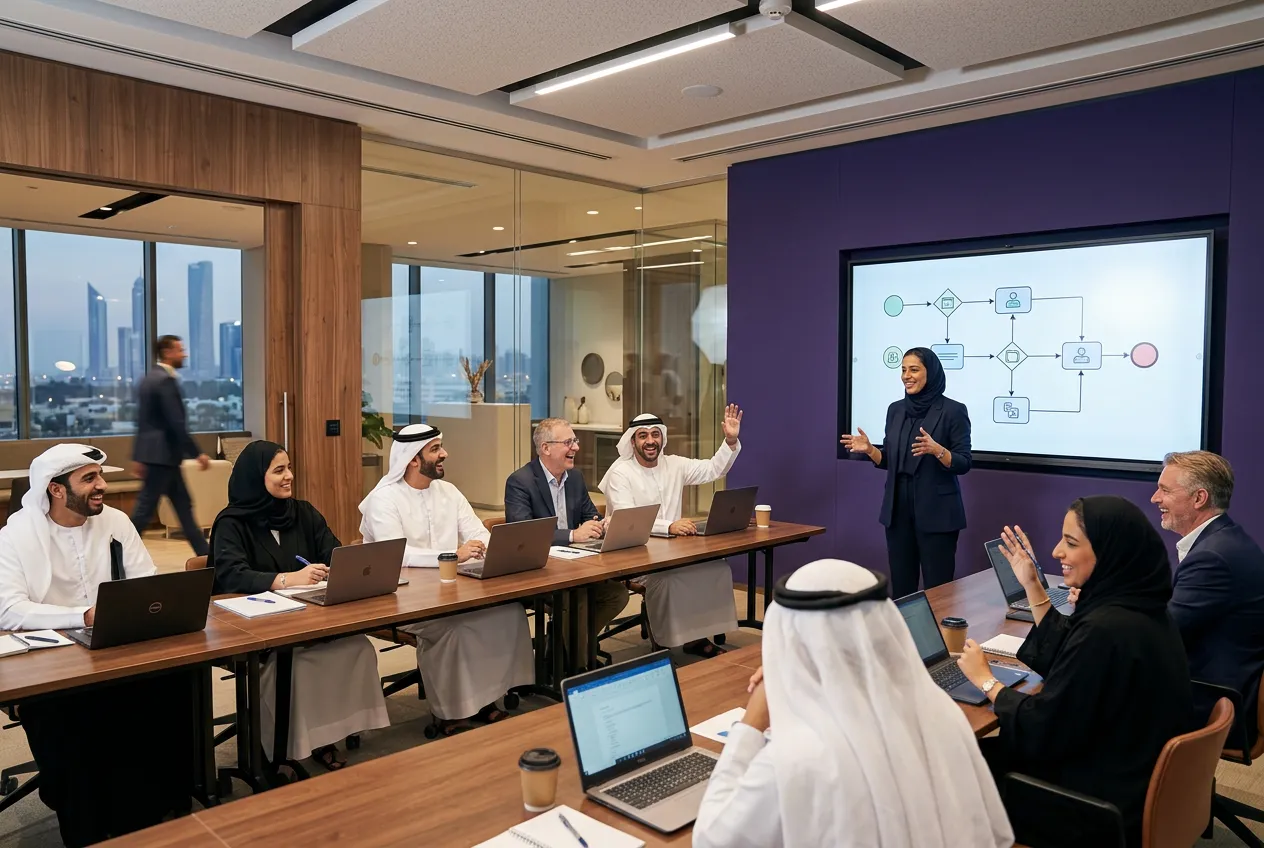
Our bench includes former service directors, commercial leaders and people managers who have worked with healthcare audiences before. They know a clinic corridor is not a boardroom, and they plan their energy and examples accordingly.
Leadership and management faculty
For managers, senior leaders and leadership offsites
- Senior people who have run teams and led change
- Drawn from a visiting faculty network across 9 IIMs
- Coaching, decision making and difficult conversations
- English, Arabic or bilingual delivery
Sales and customer trainers
For sales, account and service teams
- Practitioners who have closed deals and run sales teams
- Role plays built on your real deals and customers
- Discovery, objection handling and negotiation
- B2B, retail and hospitality experience
AI and digital trainers
For AI adoption and productivity programmes
- 17+ years in AI and corporate training
- Have trained 200,000+ professionals in 16+ countries
- Copilot, ChatGPT, Claude and Gemini on real work
- Part of a pool of around 300 trainers worldwide
Working with teams across Dubai Healthcare City
Since 2002, Dubai Healthcare City has operated as a free zone built around health. The original Oud Metha phase is where you find the hospitals, clinics and labs, along with the campus of Mohammed Bin Rashid University of Medicine and Health Sciences. Phase two, in Al Jadaf, is reserved for wellness. A Green Line metro stop carries the district’s name, so staff based elsewhere in Dubai can reach a training block easily.
Many providers here have training rooms or small auditoriums on site, and that is where most of our sessions happen. Others prefer a hotel meeting room nearby so staff are not pulled back onto the floor. Teams combine nationalities from many regions, and patients come from across the Gulf and further afield, so facilitators expect a range of attitudes to hierarchy and frankness.

Session lengths for clinical schedules
Ninety minute block
One skill, such as breaking bad news about a delay, run several times to cover each shift.
Half day
A single theme for one department, with plenty of rehearsal using anonymised situations from your unit.
Full day
Best for supervisors or commercial teams who can step away together and work through two related skills.
Two days
Suits a leadership retreat or a new manager group that needs depth, practice and agreed team commitments.
Monthly series
A session each month over a quarter, linking practice on shift with review and coaching in the room.
Corporate Trainer in Dubai Healthcare City: common questions
How is the facilitator chosen for a hospital or clinic audience?
We look at the people attending before the subject. A reception and call centre group needs someone who has run high volume service teams, while consultants respond better to a facilitator used to senior professional audiences. We then check language, tone and topic experience, and only propose a person we believe your staff will respect.
Will we get to review the trainer's background first?
Yes. Your proposal includes a written profile describing the facilitator’s management history, main topics and past audience types. Most training leads also take a short call with them. If anything about the match feels wrong, we offer an alternative before you commit to dates.
Can sessions be run in Arabic for our patient facing staff?
They can. Our bench includes Arabic speakers, English speakers and people comfortable switching between both. Patient relations teams sometimes ask for Arabic practice specifically, because many conversations with families happen in Arabic, while the explanations stay in English for colleagues who prefer it.
How many staff can join one practical session?
Practical sessions take a maximum of 20 people for every trainer, which keeps rehearsal personal and feedback specific. For a large nursing department we usually repeat the block across shifts instead of crowding one room. Staff day talks and town hall segments can be any size.
Can the training fit around clinic hours and shift handovers in Dubai Healthcare City?
Yes, and we plan for it from the first call. We avoid handover windows and peak outpatient sessions, offer early morning or late afternoon blocks and run repeats so night staff can attend. Sessions happen in your own training room or a nearby hotel, which keeps staff close if they are needed.
How far ahead should we book?
Three weeks gives the facilitator time to speak with supervisors and build scenarios from your service themes. When rotas are already published, earlier is better so managers can release people. You will always have a written proposal within 24 to 48 hours of describing what you need.
Is it possible to record the workshop for staff on leave?
Yes, provided we agree before the session. Any recording stays inside your organisation. In healthcare we take extra care: role plays use invented or anonymised details only, nothing that identifies a patient is shown, and many clients choose to record just the explanation segments.
Are certificates issued to staff who attend?
Yes. Every staff member who completes the workshop gets a certificate of completion from TrainingInUAE.com. It documents in-house corporate training on a soft skill or business topic. It is not a clinical qualification or a continuing education credit, so please do not treat it as one.
Plan your team's session
Explore more in Dubai Healthcare City and nearby
More training in Dubai Healthcare City
Nearby locations
Related programmes
- AI Agents and Automation Training in UAE: Build Working Workflows
- AI Training for Finance Teams in the UAE
- AI Training for HR Teams in the UAE
- AI Training for Sales Teams Who Want More Selling Time
- AI Training UAE: Hands On AI Training for Employees
- ChatGPT Training in UAE for Everyday Business Work
The UAE’s one stop shop for corporate training. Hands on workshops delivered across Dubai and all seven emirates. Licensed UAE company registered in Ajman, with a delivery team based in Dubai.
- AI Agents and Automation Training: Build Working Workflows
- ChatGPT Training for Everyday Business Work
- Claude AI Training for Document Heavy Teams
- Microsoft Copilot Training for Microsoft 365 Users
- Prompt Engineering Training Across Every Major AI Tool
- Business Writing Training
- Communication Skills Training
- Presentation Skills Training
- All programmes
© 2026 TrainingInUAE.com. All rights reserved.