Hire a Corporate Trainer in Dubai Internet City Who Fits the Room
Book a Corporate Trainer in Dubai Internet City chosen for the people who will actually attend. Expect a senior facilitator, a proper briefing and hands on practice on real tasks from your own team.
- You review the trainer before booking
- 80% practice, built on your cases
- Arabic, English or a bilingual mix
- Rated 4.9/5 by 200,000+ professionals
- Certificate for every participant

What you get when you book through us
Chosen for your audience
We pick the facilitator after learning who sits in the room. Engineers, account managers and regional directors each need a different style, and we match accordingly.
Seniority you can check
Every trainer has run teams, sold to demanding buyers or led change in a real organisation. You read their background before a date is fixed.
Briefed before day one
The trainer studies your documents and talks to the managers involved, so exercises use situations your people faced this quarter rather than textbook cases.
Practice fills the day
Around 80% of workshop time goes to role plays, rewrites and rehearsals. Participants spend most of the session doing, while the trainer coaches and corrects.
Language that suits everyone
Sessions run in English, Arabic or both. Mixed groups can switch language for group work so that nobody sits quietly because the wording felt hard.
Proposal and certificate
A written proposal naming the suggested trainer type arrives within 24 to 48 hours. Completing participants are awarded a certificate.

How booking a Corporate Trainer in Dubai Internet City works
Technical audiences switch off fast when a session drifts into theory. People here remember what they rehearsed, not what they were told. So the booking process is built around one goal: getting the right trainer into the room with exercises drawn from your own work.
Share the brief
Tell us the topic, the audience, the date range and what prompted the request. A short call or email is enough to start.
Receive a trainer match
We propose a facilitator whose background suits your group and send their profile, approach and a draft agenda for you to review.
Talk to the managers
The trainer holds brief calls with line managers or a few attendees to collect real examples and understand what success should look like.
Run the session
The workshop happens at your office or a nearby venue, with most of the time spent on practice using your scenarios and materials.
Collect honest feedback
Participants rate the session and the trainer captures themes raised in the room, which HR receives as a short written summary.
Follow up later
Agreed actions are checked with managers afterwards, and one success measure chosen at the start is reviewed at 90 days.

Out of a full day, roughly an hour and a half is input from the trainer. The rest is participants practising difficult conversations, presenting their own slides and getting immediate, specific feedback from the facilitator and peers.
- Laptops open from the first 15 minutes
- Your own documents, data and tasks
- A finished output from every lab
- Prompt library to keep using on Monday
Topics our trainers deliver most in Dubai Internet City
These eight topics account for most bookings from offices in the district. Each one is adapted to your industry and seniority mix, and every session centres on practice with situations your team will recognise immediately.
Topic 1. Leadership and people management
Setting expectations, running one to ones and handling underperformance, for team leads who were promoted for technical skill and now manage people across several countries.
🛠 Participants practise: A feedback conversation with a struggling team member, rehearsed twice with coaching
Topic 2. Communication and presentation
Structuring a message for senior stakeholders, cutting long updates down and presenting with confidence to headquarters, clients or a partner audience.
🛠 Participants practise: Their own upcoming presentation, delivered, critiqued and delivered again
Topic 3. Sales and negotiation
Discovery questions, handling objections and protecting margin in enterprise deals, for account teams selling software, services or media inventory across the region.
🛠 Participants practise: A live negotiation round based on a current deal in their pipeline
Topic 4. Customer service
Managing expectations, saying no without losing goodwill and recovering after a failure, for support and success teams who face demanding customers every day.
🛠 Participants practise: Rewriting a real escalation email and replaying the follow up call
Topic 5. Time management and productivity
Taming the inbox, protecting focus time and handling competing requests from a local manager and a global one, using the tools already on staff laptops.
🛠 Participants practise: A weekly plan for their real workload, tested against next week’s calendar
Topic 6. Emotional intelligence and conflict
Recognising triggers, staying calm under pressure and resolving disagreements between functions, especially where engineering and commercial priorities pull in different directions.
🛠 Participants practise: A cross team disagreement role played from both sides of the table
Topic 7. Team building facilitation
Structured sessions that build trust and agree working norms, useful after a reorganisation, a merger of teams or rapid hiring across nationalities.
🛠 Participants practise: A team charter drafted together and signed off before leaving the room
Topic 8. Train the trainer
Turning subject experts into capable internal facilitators who can onboard new hires and share product knowledge without reading from slides.
🛠 Participants practise: A fifteen minute internal session, delivered and coached on video
Matching the trainer to a district of mixed teams
A software regional office and a broadcaster may sit a few minutes apart yet need very different facilitators. Matching starts with three questions about your people, then shapes every exercise around their work.
Understand the audience
We ask about roles, seniority, nationalities and what fell flat in earlier training, because those details decide which facilitator will earn respect quickly.
Build on your material
Status reports, client emails, sales decks and survey results become the practice material, with anything confidential handled on your premises only.
Set level and language
Content is pitched for new joiners, managers or directors, and delivered in English, Arabic or a bilingual mix agreed in advance.

Formats we run
In-house workshop
A half day or full day session in your own meeting rooms, for one team and one clearly defined skill.
Leadership offsite
A facilitator for your management retreat who keeps discussion honest, on time and focused on decisions.
All hands or partner day talk
A short, interactive slot for a large audience, with exercises people can do from their seats.
Multi-session programme
The same trainer over several weeks, so learning builds steadily and progress can be tracked between sessions.
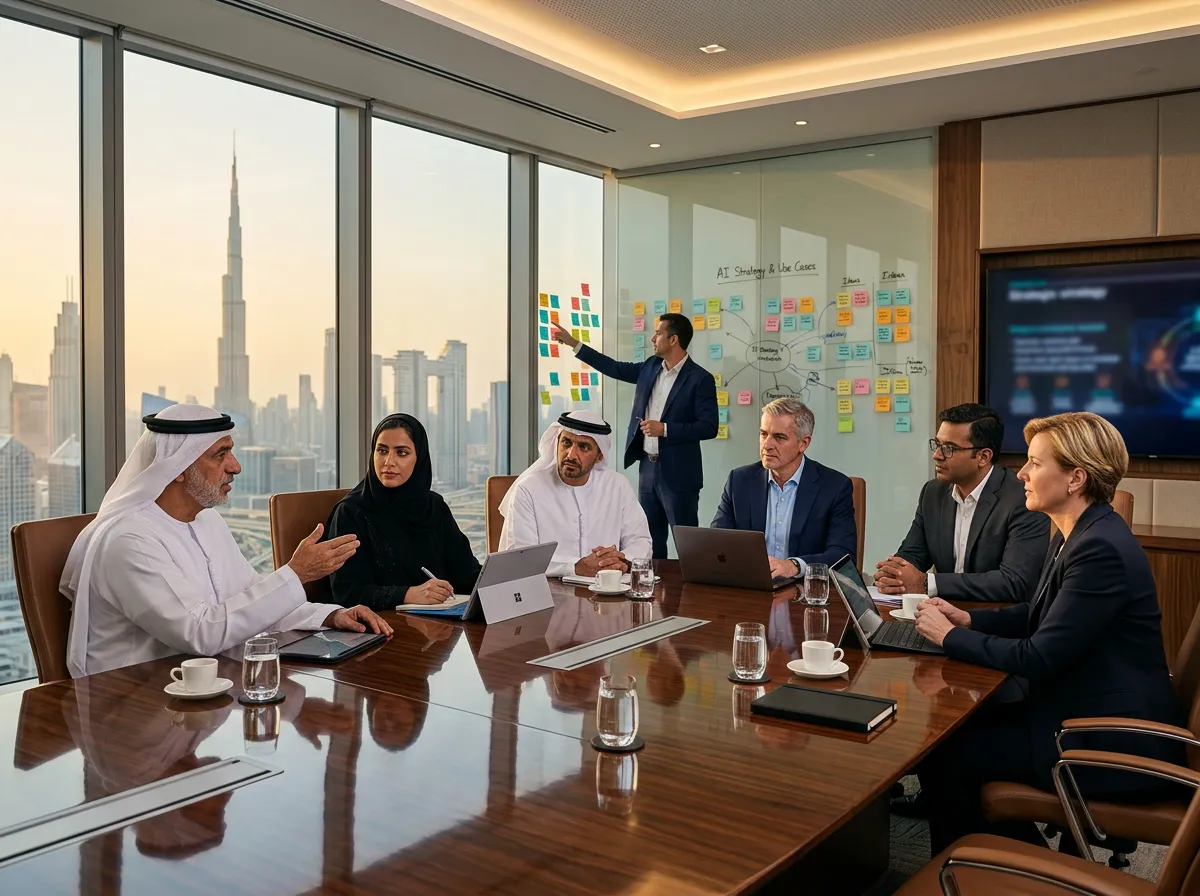
Certificates for those who complete the workshop
After a hands on workshop, each person present throughout earns a completion certificate issued by TrainingInUAE.com. It records the topic and duration for your HR files. It is an in-house training record and is not a KHDA accredited qualification.
- Issued to every participant who completes the hands on labs
- Shows the programme name, hours, tools covered and date
- Digital PDF, ready to add to LinkedIn and HR records
- Attendance and lab completion report for HR or L&D, on request

Teams in the district that book our trainers
Requests come from regional offices of global firms, local scale ups and media groups. What they share is a busy, international workforce that expects a facilitator to be sharp and relevant.
Software and cloud offices
Engineers, pre-sales and account teams who want evidence and precision, and quickly spot a trainer who has never worked in tech.
Broadcast and publishing
Editorial, production and commercial staff on irregular hours, often trained in shorter blocks around programme schedules and deadlines.
Advertising and creative agencies
Account and creative people who respond to energy and live feedback, practising on actual client briefs and pitches.
Regional headquarters functions
Finance, HR and operations teams serving many countries, who need clear communication across matrix reporting lines.
Hardware and telecoms firms
Channel, partner and service teams who sell through others and need stronger influence and negotiation skills.
Young, fast growing firms
Young companies hiring fast, where first time managers need practical people skills before habits set in.
Teams our trainers have worked with














Plus 400+ enterprise clients across 16+ countries.
Who will stand in front of your team
Each Corporate Trainer in Dubai Internet City we place is a senior practitioner who has managed people, closed deals or led change. You see the profile, background and approach before agreeing to anything.
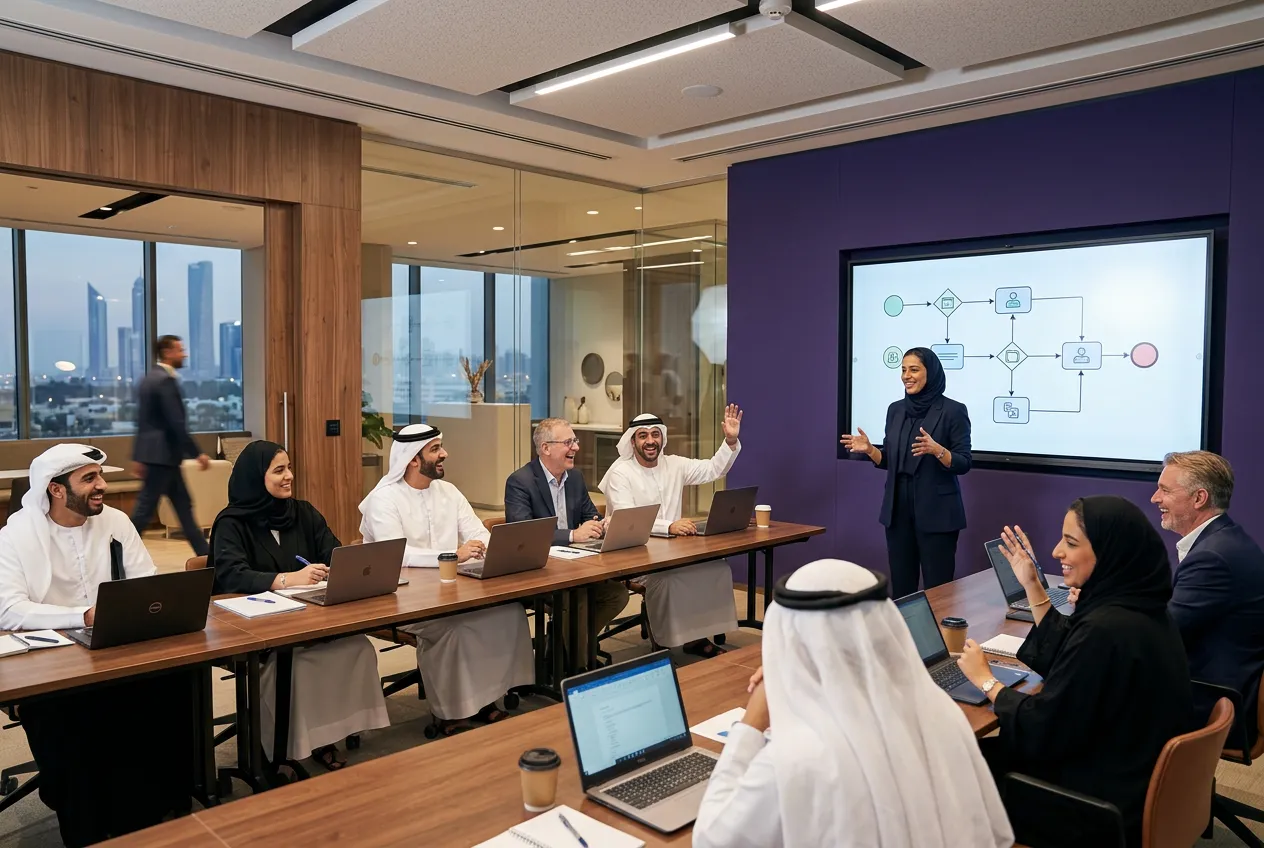
Leadership and management faculty
For managers, senior leaders and leadership offsites
- Senior people who have run teams and led change
- Drawn from a visiting faculty network across 9 IIMs
- Coaching, decision making and difficult conversations
- English, Arabic or bilingual delivery
Sales and customer trainers
For sales, account and service teams
- Practitioners who have closed deals and run sales teams
- Role plays built on your real deals and customers
- Discovery, objection handling and negotiation
- B2B, retail and hospitality experience
AI and digital trainers
For AI adoption and productivity programmes
- 17+ years in AI and corporate training
- Have trained 200,000+ professionals in 16+ countries
- Copilot, ChatGPT, Claude and Gemini on real work
- Part of a pool of around 300 trainers worldwide
Reading the room in a tech and media district
The two neighbouring districts, alongside Dubai Knowledge Park and reached from the Dubai Internet City station on the Metro Red Line, combine very different working cultures. A software firm’s regional office may have engineers who dislike role play next to account managers who thrive on it. A broadcaster can have producers on rotating schedules and commercial staff on fixed hours, which decides when training can happen.
Offices are highly multinational and English is the usual working language, though Arabic matters for teams serving government clients or local audiences. Many staff report to managers abroad, so a facilitator must understand matrix structures and global processes. A strong Corporate Trainer in Dubai Internet City adjusts tone and examples fast, keeps the agenda tightly timed and accepts that someone may step out for a call with headquarters.

Session lengths that suit a regional office
Ninety minute briefing
A focused, interactive slot for a town hall or team meeting, introducing one skill with a quick exercise.
Half day workshop
Enough time to practise one skill properly, ideal for teams that cannot leave their desks all day.
Full day workshop
A complete practical day for up to 20 people per trainer, built on their own situations.
Two day intensive
A deeper option for managers or an offsite, with time to practise, reflect and practise again.
Online live sessions
The same trainer working with colleagues in other GCC offices over video, in shorter interactive blocks.
Corporate Trainer in Dubai Internet City: FAQs
What decides which facilitator comes to our office?
We start with your audience: their roles, seniority, nationalities, preferred language and what disappointed them before. Then we propose someone whose career fits, for example a former engineering manager for a technical group or an experienced sales leader for account teams. You review the suggestion and can ask for an alternative if it does not feel right.
Will we know who the trainer is before signing off?
Yes. The proposal includes the trainer’s background, the kind of teams they have led or trained and the approach they plan to take. For most bookings the trainer also speaks briefly with whoever owns the training, so both sides can check the fit before any date is confirmed.
Is Arabic or bilingual delivery available?
It is. Our facilitators include native Arabic speakers, English specialists and people who switch comfortably between the two. Many groups in the district run mainly in English with Arabic used during discussion and group exercises. Tell us the language mix of your attendees and we will propose a trainer who handles it comfortably.
What is the largest group one trainer can handle?
Practical workshops are capped at 20 participants for each trainer, so nobody is left watching while others rehearse. Larger teams are split into cohorts with the same facilitator, or we add a second trainer. Keynote style talks and town hall sessions can take any audience size.
Will the trainer run the session at our office in Dubai Internet City?
Yes. Most sessions take place on site in your own meeting rooms, which saves travel time and keeps the material close to daily work. If you prefer a change of scene, we can run it in a hotel meeting room nearby or any venue you pick across the UAE.
How much notice do you need?
Once we have spoken, a proposal naming the trainer type follows inside 24 to 48 hours. Final dates depend on the trainer’s calendar and how much preparation the topic needs, so two to three weeks ahead works best. Shorter notice is sometimes possible for a well defined topic.
Can the session be recorded for colleagues in other offices?
Yes, recording for internal use is fine provided it is agreed ahead of the session. We normally film the trainer’s input and the summary at the end, but leave role plays unrecorded so people practise openly. Colleagues in other GCC offices can then watch the key teaching points and follow up with their own manager.
What paperwork do attendees get at the end?
Yes. Anyone who completes a hands on workshop is issued a TrainingInUAE.com certificate stating the topic, date and number of hours. It works well as evidence for internal learning records. It is not a KHDA accredited qualification or an external exam.
Describe the room, we find the trainer
Explore more in Dubai Internet City and nearby
More training in Dubai Internet City
Nearby locations
Related programmes
- AI Agents and Automation Training in UAE: Build Working Workflows
- AI Training for Finance Teams in the UAE
- AI Training for HR Teams in the UAE
- AI Training for Sales Teams Who Want More Selling Time
- AI Training UAE: Hands On AI Training for Employees
- ChatGPT Training in UAE for Everyday Business Work
The UAE’s one stop shop for corporate training. Hands on workshops delivered across Dubai and all seven emirates. Licensed UAE company registered in Ajman, with a delivery team based in Dubai.
- AI Agents and Automation Training: Build Working Workflows
- ChatGPT Training for Everyday Business Work
- Claude AI Training for Document Heavy Teams
- Microsoft Copilot Training for Microsoft 365 Users
- Prompt Engineering Training Across Every Major AI Tool
- Business Writing Training
- Communication Skills Training
- Presentation Skills Training
- All programmes
© 2026 TrainingInUAE.com. All rights reserved.