Generative AI Training in Abu Dhabi: Build Governed AI Tools
Generative AI Training in Abu Dhabi that turns capable staff into builders. Working on real tasks from their own desks, participants create assistants, agents and document workflows that your governance team can review and approve.
- Labs fill 80% of every day
- Each builder receives a completion certificate
- Designed around your data classification
- Rated 4.9/5 by 200,000+ professionals
- Certificate for every participant

Why Abu Dhabi entities choose our generative AI programme
Most of the day building
Short explanations, then long lab blocks. Participants spend the bulk of each session configuring and testing their own assistant while the trainer coaches at their shoulder.
Your papers become the labs
Board papers, procedures, tender submissions and bilingual letters, redacted where needed, form the inputs. People practise on the material they will face next week.
Governance built alongside
Each build respects your data classification, the federal PDPL and, for firms registered in ADGM, its Data Protection Regulations 2021. Nothing confidential goes into an unapproved tool.
Facilitators with real mileage
Trainers have led functions in Gulf organisations and use generative AI in their own work. They can talk to an engineer, a policy adviser and a CFO in the same room.
Certified on completion
Everyone who finishes receives a TrainingInUAE.com certificate of completion, listing the modules covered and the working build they produced.
Ninety day evidence
We baseline the chosen task before day one, fix a single metric with the sponsor and return at 30, 60 and 90 days with measured results.

Inside a Generative AI Training in Abu Dhabi lab
Reading about retrieval or agent design gives a vocabulary, not a skill. The skill appears when someone loads their own procedure into an assistant, asks it a hard question, catches the wrong answer and tightens the instructions. We structure every lab around that loop.
Nominate a task
Ahead of the lab every participant names one recurring job, perhaps building a compliance matrix or summarising technical reports for management.
Watch one technique
A brief demonstration covers a single pattern, such as citing sources from an uploaded file, using an Abu Dhabi style policy document.
Apply it hands on
Each person reproduces the pattern on their nominated task inside your approved tool, running it against several real inputs.
Challenge a colleague's build
Partners test each other’s assistants with tricky questions and Arabic inputs, logging every failure so it can be corrected on the spot.
Document what works
Final instructions and prompts are written into a team library with notes on purpose, owner and known limits.
Measure against baseline
Timings on the nominated task are compared with the pre lab figures and kept for the sponsor’s 90 day review.

Eighty per cent practice means a trainer speaks for roughly a fifth of the time. The rest is participants building, testing on real files and comparing results with colleagues around the table.
- Laptops open from the first 15 minutes
- Your own documents, data and tasks
- A finished output from every lab
- Prompt library to keep using on Monday
What our Generative AI Training in Abu Dhabi covers
The programme runs in eight modules, from model behaviour to a finished capstone. We adjust depth for each audience, and every module produces a lab output that participants carry back to their department.
Module 1. Inside large language models
Why models predict rather than know, how context length limits what they can read, and how Claude, ChatGPT, Gemini and Copilot differ in reasoning, Arabic handling and data controls.
🛠 You build: Benchmark two models on one of your Arabic and English tasks
Module 2. Prompt frameworks that scale
Moving from one off questions to structured, tested prompts that a whole unit can reuse. We cover examples, constraints, output schemas and simple version control for prompts.
🛠 You build: Turn a weak prompt into a tested template with sample outputs
Module 3. Working with long documents
Summarising studies, comparing policy drafts and querying procedures with NotebookLM, Claude Projects or Copilot, while forcing answers to cite the page they came from.
🛠 You build: Query a long procedure and verify every cited answer
Module 4. Custom assistants for your unit
Configuring custom GPTs, Claude Projects, Gemini Gems or Copilot agents with approved knowledge, firm instructions and a formal register suited to official correspondence.
🛠 You build: Set up a bilingual correspondence assistant with approved templates
Module 5. Agents and automated workflows
Using Copilot Studio, Power Automate, n8n or Make to chain steps together, and deciding which actions an agent may take alone and which need a person.
🛠 You build: Build a submission intake flow with a reviewer approval step
Module 6. Data, reports and generated content
Asking AI to analyse spreadsheets, produce charts and draft report narrative, then generating speeches, visuals and press material in both languages with checks for accuracy.
🛠 You build: Produce a dashboard narrative from an anonymised data extract
Module 7. Guardrails and responsible use
Spotting hallucinations, designing human review, Federal Decree-Law No. 45 of 2021, ADGM data protection where relevant, and the clauses an internal AI usage policy needs.
🛠 You build: Draft guardrails and a review routine for one live build
Module 8. Capstone and rollout plan
Participants complete one build for their own role, present it to the sponsor and agree who maintains it, who uses it next and how its value will be measured.
🛠 You build: Capstone: ship a working assistant or automation for your own job
Shaped around your entity and its controls
A policy unit, an engineering division and an investment team need very different builds. We map your use cases and information rules first, then design labs that fit both.
Scoping conversation
We meet the sponsor and an information security contact to agree use cases, approved platforms and which document classes can enter the lab.
Exercises from your documents
We prepare lab files from redacted versions of your own papers and set every exercise inside the tools your entity has already approved.
Depth and language by group
Senior leaders, analysts and technical staff get separate depth, and labs can run in Arabic, English or a bilingual mix.

One programme, four tracks
Leaders
Selecting high value use cases, weighing risk against benefit and setting the approval rules builders must follow.
Power users and analysts
Prompt frameworks, grounded document assistants and data analysis for the specialists who will build for their teams.
Content and communications teams
Bilingual drafting, speech and press workflows, and tone controls suited to formal and official communication.
Technical teams
Model APIs, retrieval over internal knowledge, evaluation methods and secure integration with existing systems.
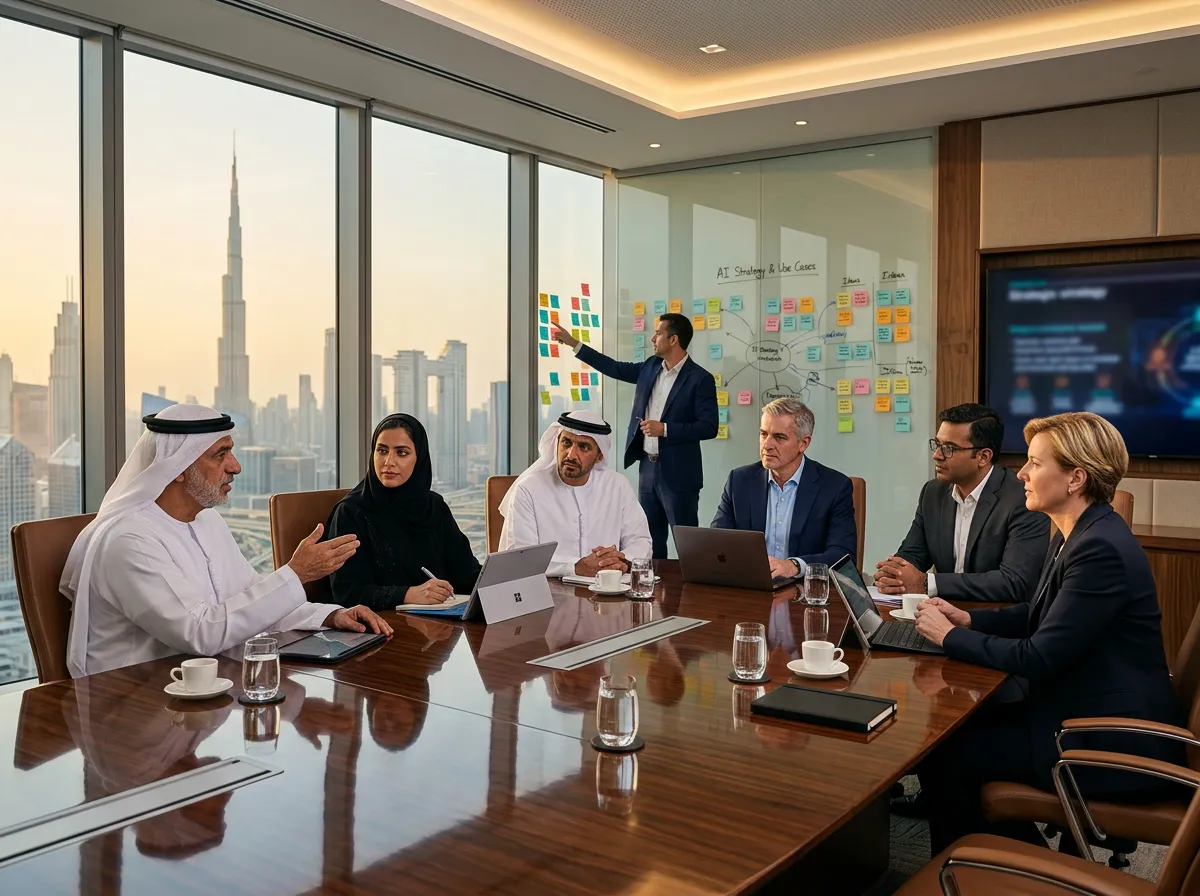
Certificates for every participant
All participants who complete the programme receive a certificate of completion issued by TrainingInUAE.com, recording the modules and their capstone build. It documents corporate training only. It is not a KHDA accredited award, and it is not issued by any AI vendor.
- Issued to every participant who completes the hands on labs
- Shows the programme name, hours, tools covered and date
- Digital PDF, ready to add to LinkedIn and HR records
- Attendance and lab completion report for HR or L&D, on request

Where our labs help across Abu Dhabi
The capital’s heaviest text workloads sit in government, energy, finance and health. We design builds for the documents each of these sectors handles every day.
Policy and strategy units
Assistants that compare drafts, summarise long studies and prepare briefing notes, with every claim traced to its source page.
Procurement and contracts
Workflows that extract key terms from supplier submissions into standard tables, leaving final evaluation with specialists.
Energy and engineering
Grounded assistants for procedures and lessons learned, run under strict information controls and technical sign off.
Investment and ADGM firms
Research digests and memo drafting inside approved environments, aligned with confidentiality duties and ADGM data rules.
Healthcare administration
Builds for policies, patient letter templates and training material, kept away from identifiable patient data.
Corporate communications
Bilingual speech, press and social drafting workflows that hold the right formal register and pass through human review.
Teams our trainers have worked with














Plus 400+ enterprise clients across 16+ countries.
Feedback from Abu Dhabi builders
Real feedback from participants in our trainers’ AI sessions. Names withheld for privacy.
“Highly recommended! Hands on and directly useful, from making PPTs and strategic plans to building KRAs.”
President, media company
“A very productive session for working professionals. A must do.”
General Manager, telecoms group
“I would recommend everyone to go through this session. It clarifies both what to expect from AI and where AI isn’t needed.”
Deputy General Manager, telecoms business services
“A nice interactive session with a lot of new insights and the power of AI. This will help me save time in routine activities.”
Senior Manager, Engineering, paints manufacturer
“The session was highly insightful and conducted in a very professional and interactive manner. Learnt about AI and excited to learn more!”
DGM, Financial Planning, paints manufacturer
“A very good training session. AI can do wonders. We’ll implement it to create efficiency and save time.”
Deputy Manager, global trading house
Senior builders run every lab
Facilitators are experienced practitioners who have managed teams and projects in the region and build with generative AI regularly. They teach from systems they have made work, not from vendor slides.
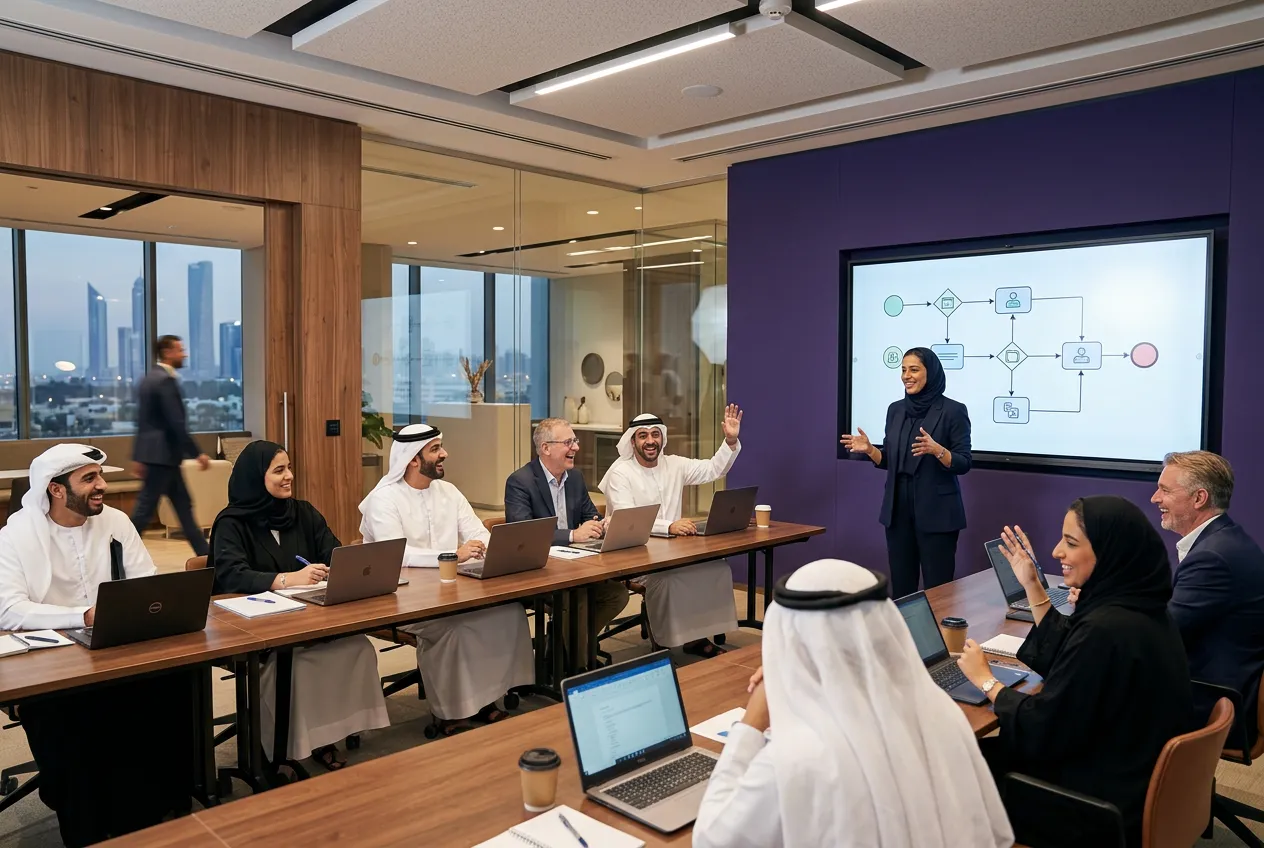
Lead generative AI trainer
Runs the room and designs your programme
- 17+ years in AI and corporate training
- Has trained 200,000+ professionals in 16+ countries
- Keynote speaker at HR and technology summits in the Middle East and Asia
- Teaches ChatGPT, Claude, Microsoft Copilot and Gemini, plus agent tools such as LangChain
Visiting faculty for leaders
AI strategy, decisions and change for senior teams
- Drawn from a visiting faculty network across 9 IIMs
- Runs AI for leaders and boardroom sessions
- Connects AI use cases to budgets, risk and KPIs
- Works alongside the lead trainer on leadership tracks
Hands on lab facilitators
Sit with your people while they build
- From a pool of around 300 trainers worldwide
- Practitioners who use AI tools in their own daily work
- One facilitator for every small group in larger cohorts
- English, Arabic or bilingual support in the labs
Generative AI in a document heavy capital
Government entities, energy companies and investment firms in Abu Dhabi generate formal documents at scale: policies, tender responses, board papers, technical procedures and bilingual correspondence. These are the workflows where generative AI saves real time, as long as output is accurate and properly reviewed. A tender team that spends days on compliance matrices, or a policy unit comparing drafts line by line, can feel the difference within one lab.
The emirate’s commitment to AI, visible in institutions such as Mohamed bin Zayed University of Artificial Intelligence, means leaders expect teams to experiment seriously. Generative AI Training in Abu Dhabi helps them move from experiments to dependable, governed workflows that management can trust, with controls designed during the build rather than bolted on later.

Programme formats for Abu Dhabi
Half day masterclass
Leaders see a live build, rank candidate use cases and agree the risk rules their teams will follow.
One day intensive lab
A single intensive day on prompt frameworks and document assistants built from the unit's own papers.
Two day bootcamp
Day one on assistants and long documents, day two on agents, guardrails and each person's capstone.
Series or academy
Fortnightly labs across a quarter, ideal for building a cohort of internal AI champions across departments.
Online live labs
Interactive remote labs for teams in Al Ain, Al Dhafra or other GCC offices, with identical build tasks.
Generative AI Training in Abu Dhabi: FAQs
How does generative AI training differ from your general AI training?
Our general AI training lifts everyday use across a workforce. Generative AI Training in Abu Dhabi is narrower and deeper. Smaller groups learn how models reason, write structured prompt libraries and build grounded assistants and agents, so the organisation ends up with internal builders rather than only confident users.
What do participants need to know before joining?
They should already use an AI chat tool for work and handle Word, Excel and PDFs comfortably. Programming is not required for the main track. Engineers and developers who want APIs and retrieval join the technical track, which assumes basic scripting knowledge.
Will each person leave with a working build?
Yes. Module 8 is a capstone in which every participant completes and presents one assistant or automation for their own role. Typical examples are a procedure question answering assistant, a supplier submission extractor or a bilingual letter drafter with a review step.
Which AI models do the labs use?
We build in whichever of Claude, ChatGPT, Gemini or Microsoft Copilot your entity has approved, and we use NotebookLM or Claude Projects for document grounding. Where a choice is still open, we benchmark two models on the same Arabic and English task so the decision rests on evidence.
Do we need enterprise licences or API keys?
Enterprise or business plans are preferable, since they give stronger data controls and the features assistants rely on. API keys are only needed for the technical track. We confirm the environment with your IT and security teams before preparing the lab files.
How is confidential material protected in the labs?
We agree document classes with your security contact, redact personal and sensitive details, and work only inside approved tools. Participants also learn the PDPL basics and, for ADGM registered firms, how the 2021 Data Protection Regulations affect what they may build.
Can the programme cover Arabic content?
Yes. Labs run in Arabic, English or both, and we test how each model handles formal Arabic, mixed language documents and translation. Communication teams practise checking Arabic drafts for accuracy and register before anything is published or sent.
How are AI agents kept under control?
Agents we build have narrow permissions, read only from approved sources and draft rather than act. Any step with external consequences waits for a named approver, and the workflow keeps a log so supervisors can see what the agent did and why.
Start with one governed build
Explore more in Abu Dhabi and nearby
More training in Abu Dhabi
Nearby locations
Related programmes
- AI Agents and Automation Training in UAE: Build Working Workflows
- AI Training for Finance Teams in the UAE
- AI Training for HR Teams in the UAE
- AI Training for Sales Teams Who Want More Selling Time
- AI Training UAE: Hands On AI Training for Employees
- ChatGPT Training in UAE for Everyday Business Work
The UAE’s one stop shop for corporate training. Hands on workshops delivered across Dubai and all seven emirates. Licensed UAE company registered in Ajman, with a delivery team based in Dubai.
- AI Agents and Automation Training: Build Working Workflows
- ChatGPT Training for Everyday Business Work
- Claude AI Training for Document Heavy Teams
- Microsoft Copilot Training for Microsoft 365 Users
- Prompt Engineering Training Across Every Major AI Tool
- Business Writing Training
- Communication Skills Training
- Presentation Skills Training
- All programmes
© 2026 TrainingInUAE.com. All rights reserved.